

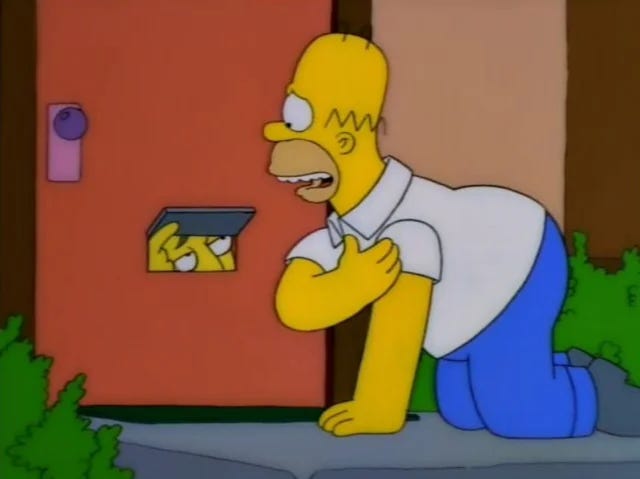
Credit: Screenshot from The Simpsons, Season 9, Episode 12, “Bart Carny’' (11 January 1998). 20th Century Fox/Disney.
In Season 9, Episode 12, “Bart Carny,” Bart causes trouble once again by crashing Hitler’s limousine at the local fair. As a result, rather than paying off the damage by taking out a loan, Bart and Homer do the most logical thing and become carnies in the fair. While tending to the booth of Cooder and Spud—a father and son carny team—Bart and Homer do not give Police Chief Wiggum a bribe and unfortunately cause Cooder and Spud’s booth to be confiscated.
Homer, feeling guilty, out of a gesture of goodwill invites the two carnies to stay with the Simpsons until they can get back on their feet. However, after drawing out the Simpsons by giving them tickets to a glass-bottom boat ride, the Cooders change the locks of the Simpsons’ residence and the Simpson family cannot enter 742 Evergreen Terrace. The following exchange ensues:
Homer: That's weird. The key doesn't fit.
Marge: Hey, someone's boarded up our windows.
Bart: Check this out!
[Bart points to fact that The Cooders have crossed out the name The Simpsons on the mailbox and written “The Cooders.”1]
Marge: What's going on?
Homer: Cooder! What have you done to our house?
[Cooder looks at the Simpsons through the mail slot and responds to them]
Cooder: It's ours now. Tell us where the extra sheets are and get off our property.
[Gasps] Lisa: They're squatting in our house.
Homer: You can't do this to me. What about the carny code?
[Cooder, Spud Laughing]
Police Chief Wiggum does not want to help the Simpsons since Homer earlier did not give the police chief a bribe, so the Simpsons are forced to live in their treehouse.
[Homer and Lisa are at the police station where Homer is speaking to Chief Wiggum]
Homer: Carnies took over our house. You've gotta help us!
Chief Wiggum: Well, well, look who's here. Mr. No-Bribe. Sure, we'll help you. Just sit down and wait for Detective Like-l-Give-A-Damn.
After spending one night in a tree house, all of the Simpsons except Marge are considering using fire to get the Cooders out of the house.
Marge: We can't just give up our home. There's gotta be a way to get those guys out of there.
Bart: I say we set fire to the house. Kill 'em that way.
Marge: We don't wanna kill them, Bart. We just want our home back.
Lisa: Well, if we did set fire to the house-
Marge: No fires!
Legal Question: What can the Simpsons legally do to get their house back? Can they use force?
Result: The Simpsons can use non-deadly force to get the Cooders out.
Legal Background: US Courts generally don’t look kindly on the concept of people taking matters into their own hands (referred to as “self-help”) to protect their property, whether this involves real estate or personal property. The main goal of the US courts is to balance allowing people to protect their property and avoiding violence as much as they can. The following table summarizes the four approaches courts take in terms of the kind of self-help they permit for people protecting their property:
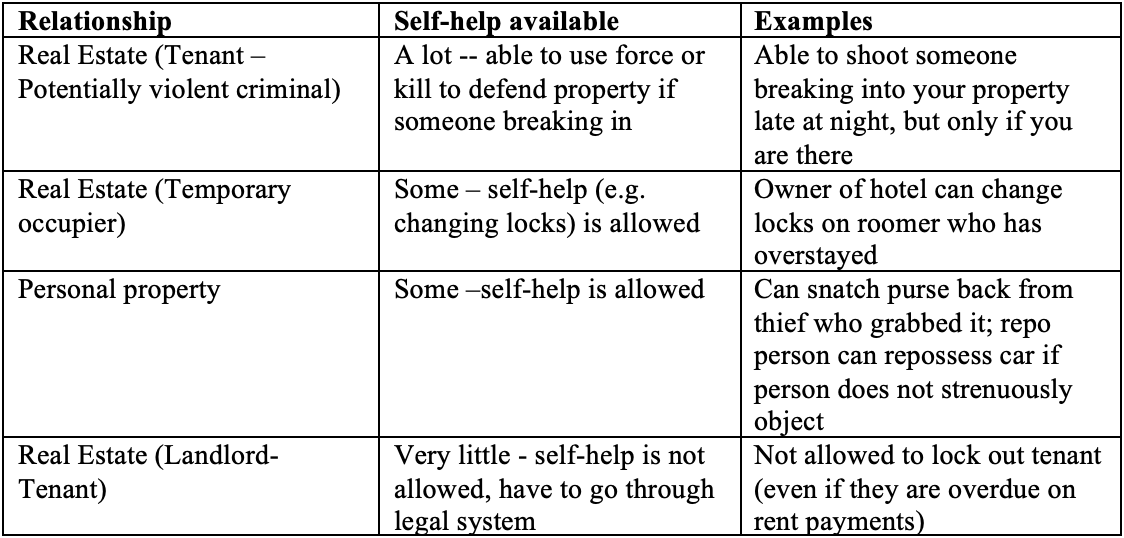
i) Real Estate (Tenant-Potentially violent criminal) If a criminal enters your house and you are clutching a baseball bat fearing for your life, US courts allow you to swing the bat or shoot at the intruder to protect yourself. The rationale being that, if you’re in your house and the other person shouldn’t be there, the person in the house is most likely a criminal, you can’t really run away and should be given the freedom to fight back. Also, you might not have the time to call the police or a court, so using violence here is acceptable. For example, in season 5 episode 10 “$pringfield (Or, how I Learned to Stop Worrying and Love Legalized Gambling),” Homer gets scared that there is a bogeyman or bogeymen in the house2, so he and the kids barricade themselves with a shotgun in the bedroom. If there were in fact a bogeyman/bogeymen in the house, Homer would have been able to legally shoot ‘em dead.
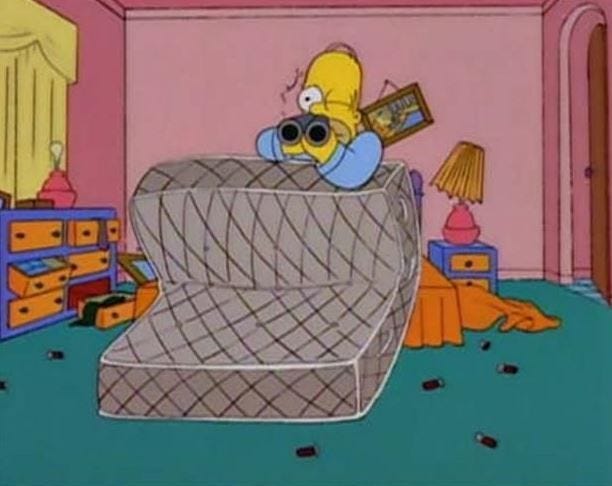
Credit: Screenshot from The Simpsons, Season 5, Episode 10, “$pringfield’' (16 December 1993). 20th Century Fox/Disney.
ii) Real Estate (Temporary occupier): If the situation involves real estate, but the person is a temporary occupier, the courts allow some self-help, but this is limited. If someone is renting a room at a hotel and they do not make payments, then courts will not allow hotel managers to excitedly rush for their shotguns and shoot the non-paying lodger off their premises. However, they will allow a hotel manager who rented their room to change the locks on a lodger who is not making payments. The rationale of the court in this case was that since the person was a temporary lodger, they are less likely to engage in violence since the hotel was not the lodger’s permanent home.
iii) Personal property: Similarly, courts allow some self-help if the question involves personal property. Personal property is, for example, a car, a vase, or a pineapple, rather than something fixed like real estate.
The most typical example for self-help in the United States for personal property self-help involves cases where repo companies took away the cars of people who did not make necessary payments. Unless the person strongly objected, the repo people could haul off a car without involving the police. Also, on a more low-level scale, if someone grabs your purse, you are allowed to grab it back from them without involving the police. You cannot shoot the purse snatcher. Similarly, the repo people cannot haul back a car while shooting at the person behind on their payments. However, some self help is allowed.
iv) Real Estate (Landlord-tenant): Cases where generally courts strongly frown upon any sort of self-help is cases where there is a landlord who has a formal rental agreement with a tenant. In these cases, no matter if the tenant failed to make payments for many months or is violating any terms of the lease, the landlord is not allowed to use self-help. They have to go through the courts. The argument being that, particularly if the house is someone’s home or their business giving them a livelihood, they are likely to react with violence if the landlord changes the locks on them or makes them leave in some other way. In the case of landlords and tenants, courts always prefer that landlords do not handle the dispute themselves, but wait until courts resolve the matter. For example, in Season 3, episode 22, “The Otto Show,” it was most likely illegal for Otto’s landlord to change the locks on him to evict him.
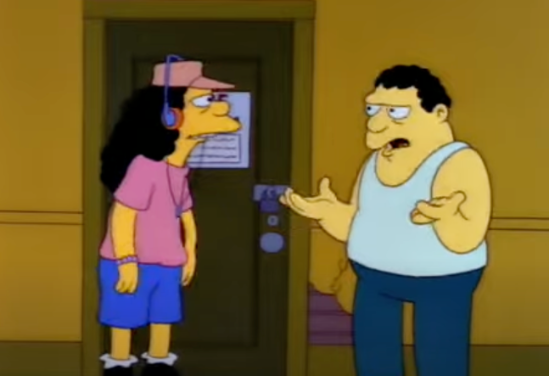
Credit: Screenshot from The Simpsons, Season 3, Episode 22, “$pringfield’' (23 April 1992). 20th Century Fox/Disney.
Analysis: If we try to slot the situation between the Simpsons and the Cooders in one of these categories, where would you put them?
It’s not a perfect fit, but the category that applies is category 2 (temporary occupiers), since it fits much better than the other categories.
Personal property is certainly not relevant since the Cooders have taken over the Simpsons’ house, not a movable object like a car or a purse. Category 1 (Tenant - Potentially violent criminal) does not apply since, although the Cooders have taken over the Simpsons’ house, they no longer presented a physical threat to the Simpsons. Category 4 (Landlord-tenant) also does not apply, since while the Simpsons let the Cooders stay at their place, it would be a stretch to say that the Cooders would qualify as the tenants of the Simpsons since no tenancy agreement was signed.
As a result, the category that best applies is likely Category 2 (temporary occupier) and, as a result, the Simpsons would be able to use some self-help. While they would not be able to set fire to get the Cooders out or use in any sort of violence, they are allowed to use other non-violent methods. In the episode, the Simpsons tricked the Cooders to get back into the house by luring them out, which the courts would certainly approve. However, the Simpsons would likely be able to use any number of other non-violent actions like using a locksmith to change the locks on the Cooders while the Cooders are getting groceries.
So, even though the Simpsons would not be able to smoke out the Cooders using fire, they would not be entirely helpless in getting rid of the Cooders. How the “Carny Code” would apply in this situation is a separate question that is not in the scope of this blog post.
The fact that Cooder and Spud put “The Cooders” on the mailbox suggests that “Cooder” is their last name and that the carny dad uses it as his first name. This is similar to how Malfoy in Harry Potter uses his last name rather than his first name Draco. The other less likely possibility is that the carny dad’s name is “Cooder Cooder.”
Never clearly established.