

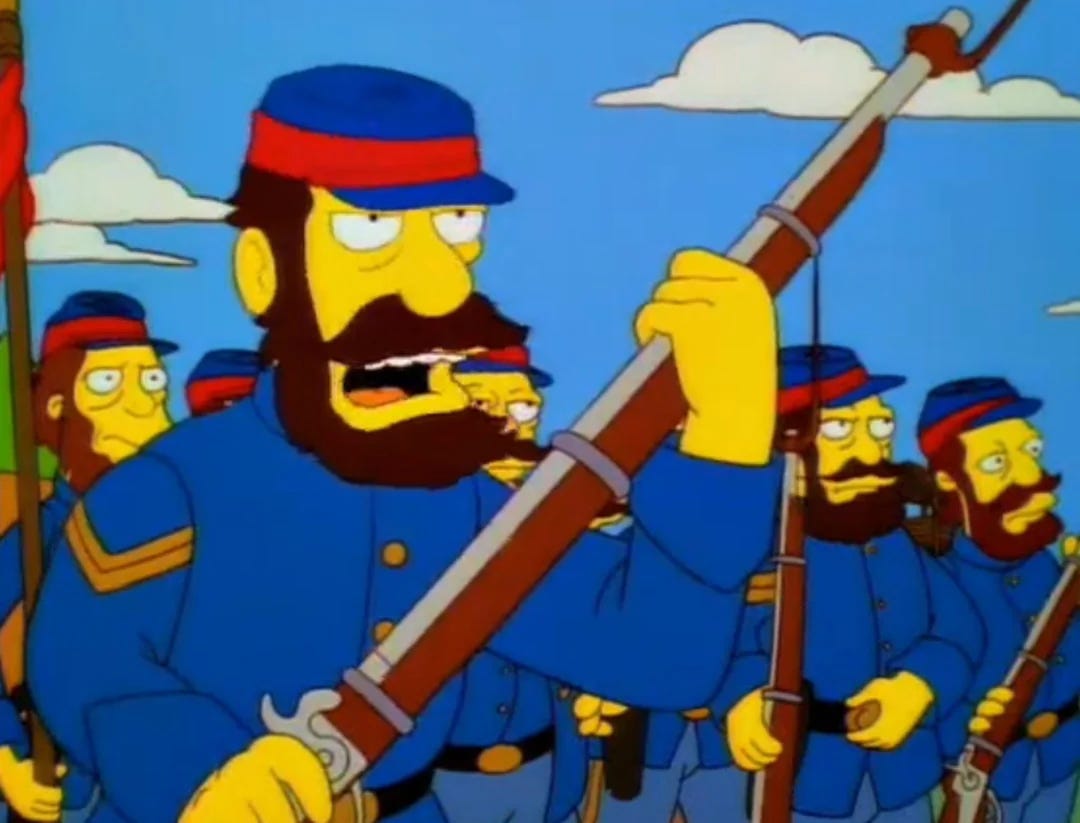
Credit: Screenshot from The Simpsons, Season 6, Episode 21, “The PTA Disbands ’' (16 April 1995). 20th Century Fox/Disney.
In The Simpsons Season 6, Episode 21, “The PTA Disbands,” students from Springfield Elementary on a field trip watch a reenactment sequence that involves a meeting between Springfield Union soldiers and Confederate soldiers. In the reenactment, the Springfield Union soldiers killed the Confederates who were surrendering and wanted shelter. The reenactment went like this:
Narrator: On May 21, 1864, the men of the 9th Bearded infantry...were sunning and fluffing their beards in the sun. Suddenly, enemy troops crested that hill over there.
Confederate Soldier 1: Fort Springfield, we surrender unconditionally!
Confederate Soldier 2: We’re sick! We need leeches... and hacksaws to saw off our gangrenous limbs.
Narrator: But the Springfield brigade was too brave to accept their surrender.
Union Soldier: Come on, boys! Those white flags are no match for our muskets! Charge!
[Union troops charge the surrendering Confederate Army]
Narrator: And the Springfielders heroically slaughtered their enemies...as they prayed for mercy.
Legal Question: Are such actions by the US Union army a violation of the laws of war?
Result: Most likely, yes.
Legal Background: I have spent a decent amount of time studying international criminal law and the law of war, so this case is particularly interesting to me. This situation in the Simpsons is particularly interesting for two reasons:
Location: Had these killings occurred anywhere else in the world at that time, they likely wouldn’t have been considered a crime.
Timing: Had they happened just two years earlier, they wouldn’t have been a crime either.
This is because of something called the Lieber Code, an order passed by Abraham Lincoln (also called General Order No. 100) in 1863. The Lieber Code is one of the best legacies of the United States to international law in that it was the first comprehensive code of military law. It is named after Francis Lieber, its main author. He’s a very interesting figure and I’d encourage you to read about him. He was quite personally invested in making the war humane, given that he had two sons fighting for the Union Army, and one son fighting for the Confederacy.

Credit: Wikimedia Commons.
The Lieber Code had a whole set of provisions such as how to treat prisoners of war, the protection of private property, and the protection of women and children, that are still relevant today.
Analysis: The relevant international criminal law principle in this case is the one of “not giving quarter.” Simply put, “not giving quarter” is a fundamental principle of international criminal law that when an enemy is trying to surrender to you, you have to accept their surrender. You can’t refuse their surrender and slaughter them.
Fortunately, the principle has been incorporated in many different places in international criminal law, such as in the Additional Protocols of the Geneva Conventions, the Rome Statute of the International Criminal Court, and most military manuals.
In the case of the Lieber Code, it clearly set out the rules related to not giving quarter in Article 60. It reads:
It is against the usage of modern war to resolve, in hatred and revenge, to give no quarter. No body of troops has the right to declare that it will not give, and therefore will not expect, quarter; but a commander is permitted to direct his troops to give no quarter, in great straits, when his own salvation makes it impossible to cumber himself with prisoners.
In case the language is unclear, it just means that a Union army has to accept a surrender, except when taking on prisoners of war would endanger the Union Army’s own safety.
Here, given that the Ninth Bearded Infantry was “sunning and fluffing their beards in the sun,” it did not appear that they were in “great straits” and that they were unable to take on prisoners. However, there is limited information. Perhaps the Ninth Bearded infantry had a perilous march the next day to attack Shelbyville and so could not take on prisoners. If these facts came to light, then perhaps the refusal to give quarter could be justified under the narrow ‘great straits’ exception.
As the facts are written, the Ninth Bearded Infantry did commit a war crime and would likely face punishment in a Union Army Court. The scene may be satire, but the rule it highlights, that even enemies deserve mercy when they surrender, remains a cornerstone of modern humanitarian law.