

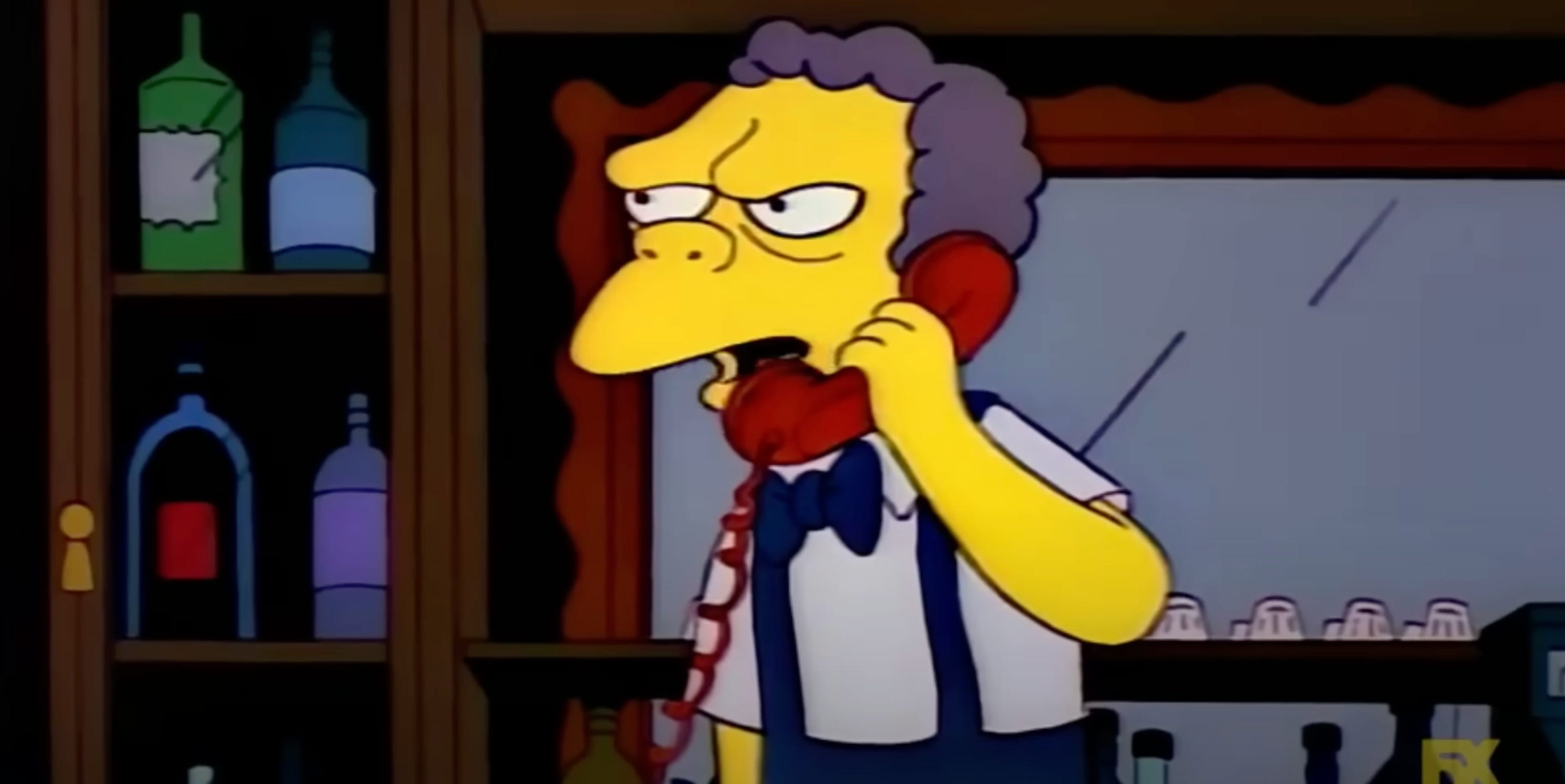
Credit: Screenshot from The Simpsons, Season 4, Episode 8, “New Kid on the Block’' (12 November 1992). 20th Century Fox/Disney.
Prank calls are a common feature of the Simpsons. The most common perpetrator is Bart Simpson who does prank calling against barman Moe Szyslak.
(Moe answers the phone)
Moe: Moe’s Tavern, where the elite meet to drink.
Bart: Uh, hello. Is Mike there? Last name, Rotch.
Moe: Hold on, I’ll check. (calls) Mike Rotch! Mike Rotch! Hey, has anybody seen Mike Rotch lately? (barflies laugh)
Moe: Listen, you little puke. One of these days, I’m going to catch you, and I’m going to carve my name on your back with an ice pick.
Also, Homer Simpson in Deep Space Homer makes a number of calls to the government.
Homer: Hello, is this NASA? Yes. Good. Listen. I’m sick of your boring space launches. I’m just an ordinary, blue-collar slob, but I know what I likes on TV.
NASA Official: How did you get this number?
Homer: Shut up! And another thing, how come I can’t get no Tang around here?
[Homer on a different call without the other side being heard]
Homer: Hello, is this President Clinton? Good! I figured if anyone knew where to get some Tang, it’d be you. Shut up!
Legal Question: Is either kind of calling illegal that could carry any sort of criminal or monetary fine?
Result: Bart’s calls are illegal, unclear if Homer’s are, but neither likely to face any consequences.
Legal Background: This is a pretty niche issue, but states have addressed prank calling through two avenues. First, there are specific laws focusing on harassment through electronic communication. As you could imagine, the federal government hasn’t spent times dealing specifically with the issue of prank calling, but some states have picked it up like New Hampshire and California. Features that are common across them are a prohibition of:
Annoying or harassing someone
Calling repeatedly
Possible consequences include a fine of around $1,000 or jail time. Second, there are general catch-all laws. If no specific laws are on the books, there are simply general catch all laws for disorderly conduct, harassment, or domestic violence.
However, even if these laws are on the books, it doesn’t seem like police departments actively go after these cases. Even in egregious cases, proving guilt is difficult. For example, David R. Stewart infamously called a McDonald’s in Kentucky in 2004 impersonating a police officer and asked the staff to harass and abuse 18-year old Louise Osgborn. Stewart was acquitted due to a lack of evidence as there were no witnesses and no recording of the phone call.
Result: Here, Bart is clearly making annoying calls and has made around 40 of them to Moe’s Tavern. Bart’s actions would be covered by the New Hampshire and California laws.
Homer’s calls to NASA and the White House aren’t to harass or annoy, but has, in his mind, serious grievances related to space launches and Tang. Homer also enjoys First Amendment protections for criticizing the government, so it’s different than Bart calling “Moe’s” a private business. However, even with free speech protections, repeatedly calling and being abusive could theoretically cross into disrupting government operations, though Homer’s couple of calls wouldn’t reach that threshold.
In either case, neither would likely face any meaningful consequences. Would be interesting to see an episode where Bart is on the other end of a prank phone call. Might be a better deterrent than any law.
For additional information on the topic, please see posts by Simrin Law Group and Howie Law Office.