

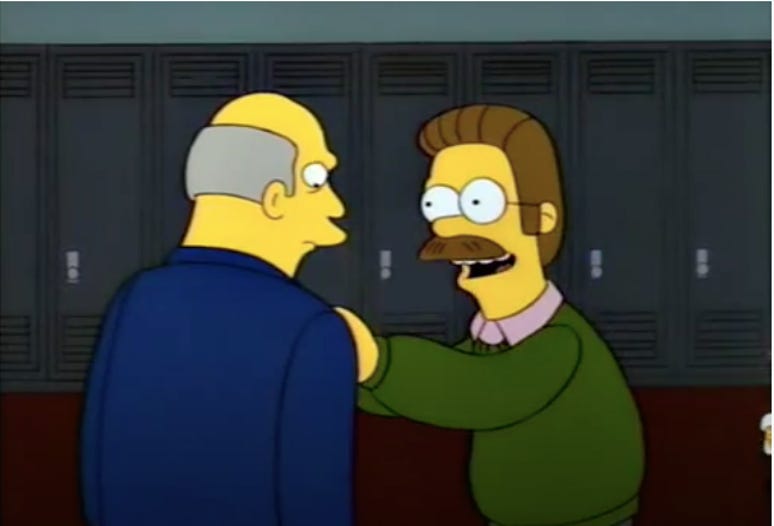
Credit: "Screenshot from The Simpsons, Season 5, Episode 19, 'Sweet Seymour Skinner’s Baadasssss Song’' (28 April 1994). 20th Century Fox/Disney.
In Season 5, Episode 19, “Sweet Seymour Skinner’s Baadasssss Song,” Principal Skinner is fired by the school for the duration of the episode. In his place, Superintendent Chalmers instates Ned Flanders, who, as most Simpsons fans know, is one of the most religious people in Springfield. Towards the end of the episode, Ned makes a morning announcement on the school intercom:
Ned Flanders: [over the intercom] Well, cockilly-doodilly-do, little buddies. Let's thank the Lord for another beautiful school day.
Superintendent Chalmers: Thank the Lor-- Thank the Lord? That sounded like a prayer. A prayer! A prayer in a public school! God has no place within these walls...just like facts have no place within organized religion! Simpson, you get your wish. Flanders is history.
[Outside in the hall]
Ned Flanders: Well, I really enjoyed my time here, Superintendent. May the Lord bless and keep you.
Superintendent Chalmers: Yeah, take it outside, God boy.
Ned Flanders: Okilly-dokilly.
Legal Question: Is Ned Flanders able to lead his students in prayer as principal in a public school?
Result: No, Springfield Elementary most likely wins this case.
Legal Background: In short, the Supreme Court’s approach to prayer in public schools boils down to the rule: feel free to do it yourself, but don’t push your religion onto other people, especially if you work at the school. In the United States, this is also part of the broader principle of the separation of church and state.
The Supreme Court has been very sensitive to even the most minimal endorsement of public school officials of religion and has stamped it out each time, with only a slight change in 2022. In the groundbreaking case Engel v. Vitale (1962), the US Supreme Court gave a big no to the New York School Board when it tried to institute a morning prayer at the school.
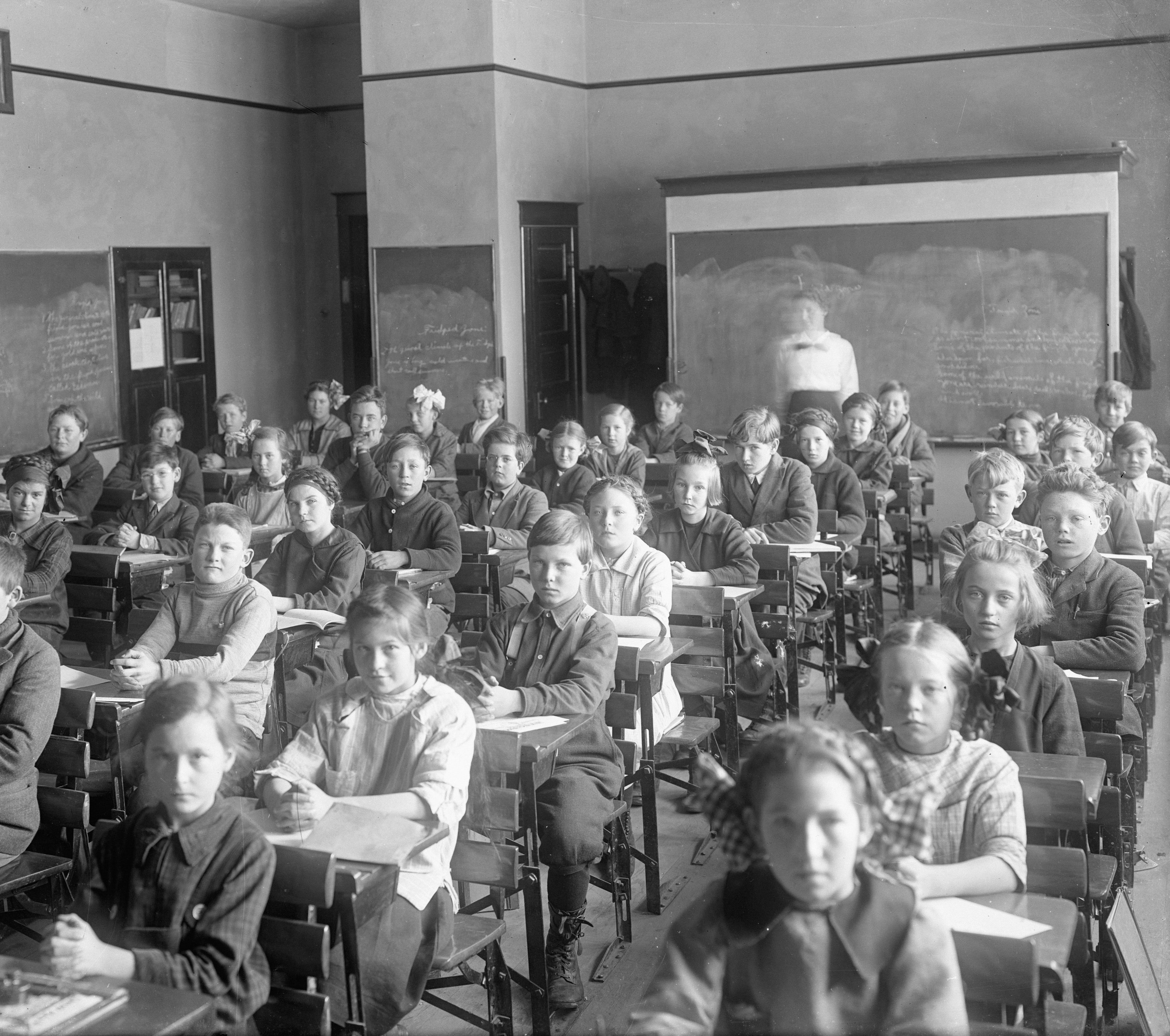
Cred: The Oregon State University Collections and Archives
Even though the prayer was completely voluntary and nondenominational, the Court still ruled it was unconstitutional. Since then, the Court has continued to stamp out any religious exercise in public schools in a set of cases called the "School Prayer Cases." For example, the Court ruled against Alabama giving students one minute for meditation or prayer and against a school district that invited a rabbi to give a nondenominational prayer at a Rhode Island school graduation.
In 2022, the Court did change tack slightly when it ruled in favor of a football coach who “silently prayed” after football games in the case Kennedy v. Bremerton School District (2022). The Court stated that school officials have the right to religious expression, even though they cannot push this onto their impressionable students. In reality, Kennedy’s speeches were not quite “silent” and reportedly involved him giving speeches to students with religious references while holding a student helmet in the air. However, as far as the Supreme Court is concerned, a teacher can pray quietly to themselves during lunch or wear a yarmulke to school, but involving students in the slightest way is prohibited.
Analysis: In this case, did Flanders even slightly involve students in his prayer? He did. If it were a different scenario and Flanders prayed silently at lunch in the cafeteria while enjoying some plain white bread dipped in water as he does, there would not have been a constitutional violation. If students had come to his office to join him in prayer like students joined Coach Kennedy, this conduct also might have been protected as Ned practicing his religion.
However, here Flanders is saying “Let’s thank the Lord for another beautiful day” over the school’s morning announcements. If Flanders had simply said “Thank the Lord for another beautiful school day”, Flanders could have argued that this was more self-expression, but his action was not silent and there does seem to be some light coercion of students going on here. It would depend on the facts of the case and perhaps the currently more conservative Supreme Court would rule in Ned's favor, but odds are Ned would have to stop being the school principal due to his actions and return to his job selling left-handed goods at the Leftorium.