

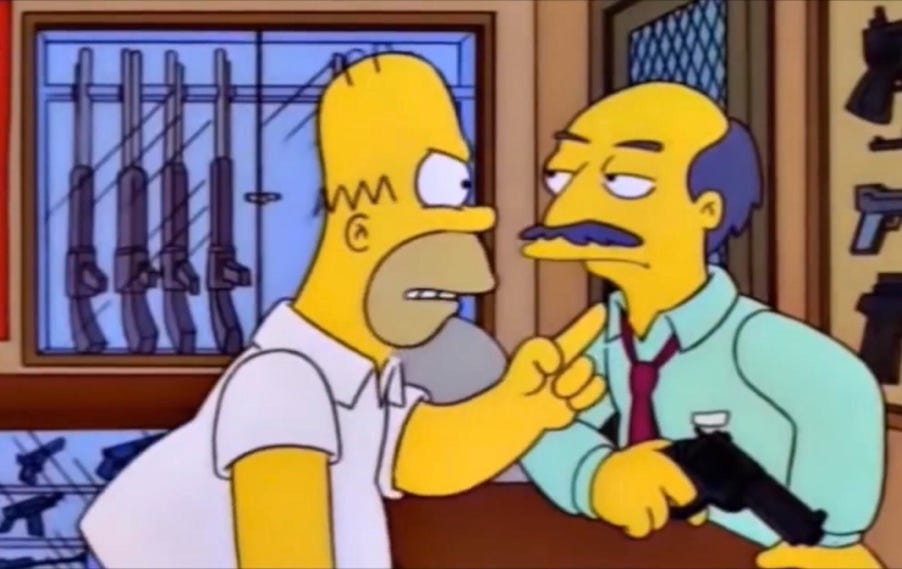
Credit: "Screenshot from The Simpsons, Season 9, Episode 5, 'The Cartridge Family’' (2 November 1997). 20th Century Fox/Disney.
In Season 9, Episode 5 “The Cartridge Family,” Homer attempts to buy a gun from the local gun shop in Springfield. However, as he is about to buy the gun, he has the following conversation with Raphael, the gun-store clerk:
Homer: …Just give me my gun. (Homer tries to take the gun)
Clerk: I'm sorry, but the law requires a five-day waiting period. We've got to run a background check.
Homer: Five days? But I'm mad now. I'd kill you if I had my gun.
Clerk: Yeah, well you don't.
[Homer walks out of the store, muttering.]
Legal Question: In the episode, Homer ends up passing the waiting period and getting a gun. However, suppose Raphael did not sell the gun to him since Homer did not pass the background check or since Homer told him “I’d kill you if I had my gun.” If Homer sued Raphael and the Springfield Gun Shop for not wanting to sell him a gun, would he win the case?
Result: Springfield Gun Shop wins.
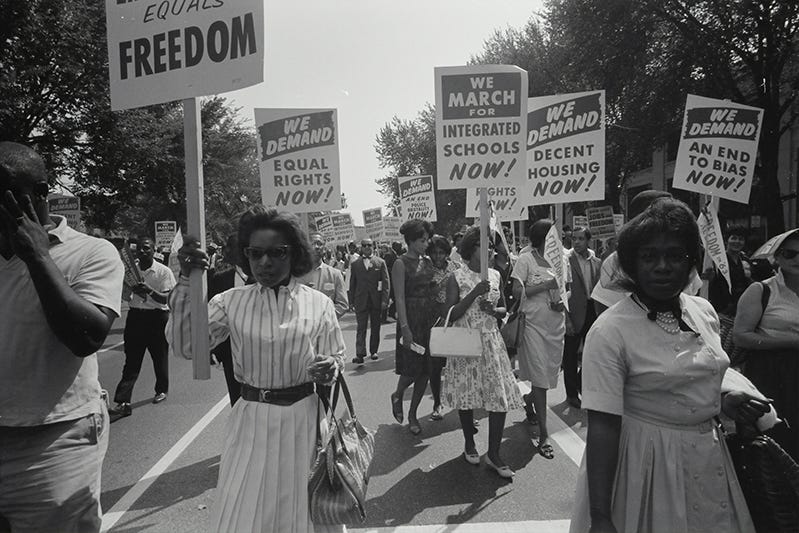
Legal Background: Interestingly enough, the relevant law in this case isn’t tied to the second amendment about the right to legally own firearms. Rather, the relevant law here is related to the 1964 Civil Rights Act, which was a seminal piece of legislation in US history. US Supreme Court decisions in the aftermath of this act have in effect created two types of refusals in shops: prohibited and permitted refusals.
(1) - Prohibited Refusals: Thanks to the Civil Rights Act of 1964, shop owners are absolutely prohibited from discriminating on the basis of race, gender, ethnicity or religion.
Credit: Unsplash
The US Supreme Court affirmed these rights through a number of US Supreme Court cases in the 1960s. It repeatedly ruled in favor of African-Americans who were unjustly refused service at hotels, amusement parks and restaurants, most famously in the case Heart of Atlanta, Inc. v. United States (1964).
(2) - Permitted Refusals: However, if there is no discrimination on the basis of race, gender, ethnicity or religion, shop owners actually can kick out of their store whomever they’d like. In the 1970s, irritated shop owners started turning away hippies with impunity through their “No shirt, no shoes, and no service” and have merrily continued doing so ever since.

Credit: Vasilios Muselimis
Store owners are even allowed to discriminate against customers if the refusal is based on their religious belief. An interesting case involves the cases Masterpiece Cakeshop v. Colorado Civil Rights Commission (2018) and 303 Creative LLC v. Elenis (2023) where the Court said, respectively, that a Christian cakemaker and web designer cannot be forced to make a wedding cake or a website for gay weddings if it violates their religious beliefs.
Analysis: In summary, as long as Raphael’s refusal to sell Homer a gun was not motivated by some sort of unjust discrimination, Raphael has a lot of freedom to handle customers in the way he likes, including Homer.
Is there any indication that Homer is being discriminated against? It doesn’t look like it. Would Homer have a case in any situation?
Well, if some new facts came to light that Raphael refused to sell Homer a gun due to Homer’s religion. For instance, if Raphael hated Stonecutters and he knew that Homer was a Stonecutter, maybe it could be argued that the Stonecutters were a religion and Homer was discriminated under the 1964 Civil Rights Act. However, as the facts stand, Homer doesn’t really have a case.
So, like shop owners turning away hippies who don’t have to justify why they turned them away, the gun shop owner doesn’t have to go to great lengths to explain why he turned away Homer from his gun shop, even though he’s “mad now.” Probably for the best.