

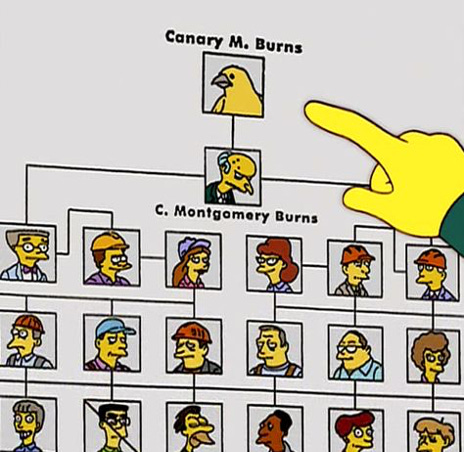
Credit: Screenshot from The Simpsons, Season 14, Episode 15, “C.E.D’oh ’' (16 March 2003). 20th Century Fox/Disney.
In Season 14, Episode 15, “C.E.D’oh,” Homer overhears how Mr. Burns organized his power plant to avoid corporate responsibility for dumping nuclear waste by placing a canary as the head of the nuclear power plant.
Smithers: Sir, we could be in real trouble here. If the government found out... you dumped nuclear waste under Lego Land...
Mr. Burns: Oh, Smithers, the environmental effects won’t be visible for years.
…
Smithers: For dumping that waste, you could go to jail. A handsome man like you, I’d hate to think what would happen.
Mr. Burns: Ha, ha, I wouldn’t go to jail. The legal owner of this plant would, Canary M. Burns.
[Shows the management structure of the power plant is under the control of a canary]
Mr. Burns: This entire plant is in his name. So when they come to put C.M. Burns in jail, it’s the canary that does the time.
Smithers: Sir, can you do that?
Mr. Burns: Oh, yes. Tycoons have been doing it for years. Why, Standard Oil was once owned by a half-eaten breakfast.
Legal Question: Is Mr. Burns’s claim in any way plausible? Could an animal own property like this?
Result: Mr. Burns cannot give Canary M. Burns legal ownership of the power plant.
Legal Background: In the 1990s, US states began enacting what are called “pet trusts” and by 2016 all 50 states had enacted legislation permitting a pet trust.
Before we get into pet trusts, a little background is needed to explain what a “trust” is. Trusts are often mocked on TV as funds that rich parents stuff money into to benefit their spoiled children. This is one use of a trust, but a trust has a more general application. In short, a trust just involves Person A giving Person B some kind of property, and Person B has to faithfully manage this property on behalf of Person C. This property that Person A gives can be any sort of property, including cash money, a flashy boat, ownership of farmland or Invidia stock certificates.
Pet trusts work in much the same way, but are slightly narrower. While you can put almost anything in a trust for a human, state legislatures have designed pet trust states primarily to help care for the animal. For example, in the Simpsons universe, this could involve Eleanor Abernathy (known also as “The Crazy Cat Lady”) putting money into a fund so an administrator can pay for someone to take care of and feed the cats if Eleanor passed away.
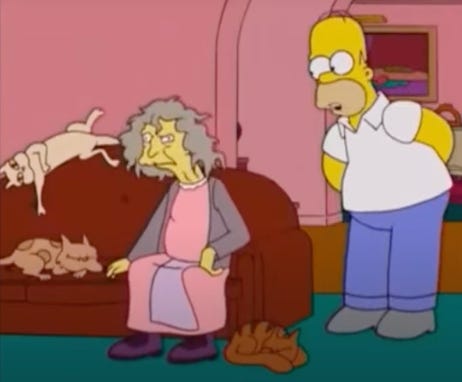
Credit: Screenshot from The Simpsons, Season 17, Episode 5, “The Last of the Red Hat Mamas ’’ (27 November 2005). 20th Century Fox/Disney.
Analysis: Here, Mr. Burns could have made an agreement that placed the ownership shares of the nuclear power plant “for the benefit of the canary”. However, based on how the pet trust statutes are drafted, a US judge would most likely rule that the pet trust law was designed to set up funding to allow a trust administrator to pay for food for the pet and for someone to take care of its daily needs.
It would be hard to argue that Mr. Burns giving Canary M. Burns ownership of the plant is related to caring for the canary, and was anything more than Mr. Burns trying to hide his assets. If Mr. Burns put a large amount of money in the pet trust, it would be different, but this likely wouldn’t work with the nuclear power plant. So here, it wouldn’t be the “canary” that does the time, but Mr. Burns.