

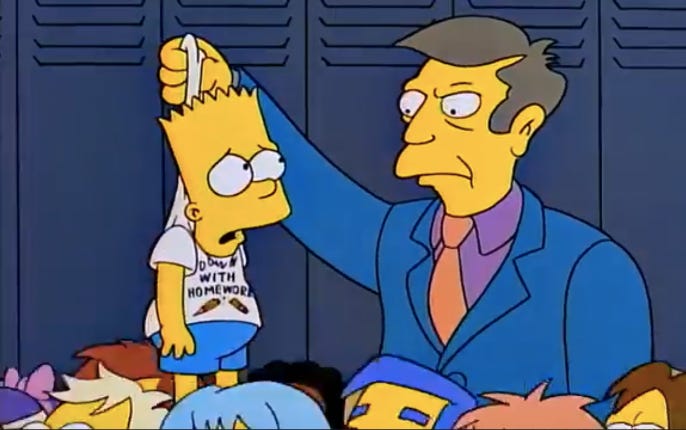
Credit: "Screenshot from The Simpsons, Season 7, Episode 12, 'Team Homer' (7 January 1996). 20th Century Fox/Disney.
In Season 7, Episode 12, “Team Homer,” Bart wears a T-shirt to school that says “Down with homework”:
Teacher Edna Krabappel: Tonight's homework assignment is—
Bart: Oh, man, is it hot in here. I'd better take off my sweater.
[Bart takes off sweater to reveal shirt]
Edna: [reads shirt] "Down with"- "homework"?
[Children start laughing as Bart stands up in his chair and shows the shirt]
Krabappel: Don't look at it, children.
Milhouse: His shirt makes a good point.
Nelson: I'm with the shirt! Homework rots!
Students: [chanting together] Down with homework! Down with homework!
[All students in the classroom throw their books out of the window, a student makes dust fly up by clapping two erasers, students tip over a desk which somehow starts a fire. Shortly after, students race through the hallways and trample the superintendent]
Superintendent Chalmers: Skinner, why are there children walking on my head?
Bart is handed some tough justice by Principal Skinner as he is forced to remove the shirt, throw it in the garbage, and wear a couch cushion back home instead of a shirt. Then, Skinner mentions that he would have to think about Bart’s punishment.
Legal Question: By throwing Bart’s shirt in the trash (and punishing him), did Principal Skinner violate Bart’s free speech rights? If Bart sued Springfield Elementary, how would a court have ruled?
Result: Springfield Elementary would almost certainly win in this case.
Legal Background: The first amendment of the US constitution without question guarantees free speech, including the right of students to express themselves in school. However, the school can still tell students to shut up or punish them if the speech is disruptive to running the school. The logic being that teachers need to be able to teach the students, and they cannot do so effectively if students are throwing the F-bomb around, telling their students to use drugs, or being otherwise disruptive. The school is effectively the parent in school and is given a large amount of freedom in regulating the speech of its students.
For example, the US Supreme Court (often called just "the Court") ruled against the student Matthew Fraser in 1986 when he gave a speech at an assembly laced with sexual innuendo, against a student who was suspended for hosting a banner saying “Bong hits 4 Jesus” at a school event, and against a school newspaper that wanted to publish articles related to pregnancy and divorce.
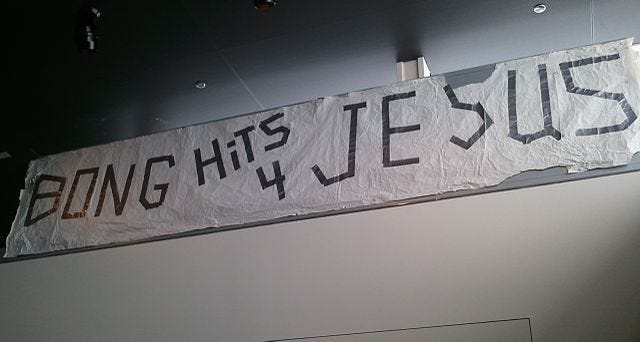
Credit: Mischafer, Wikimedia Commons
However, if the speech is not disruptive or not happening in school, US law does protect that speech. In the famous US Supreme Court case Tinker v. Des Moines (1969), the US Supreme Court ruled in favor of a brother and sister who wore black armbands to protest the Vietnam War. More recently, the Court ruled in favor of a school cheerleader who had been suspended from her cheerleading squad for posting “fuck school fuck softball fuck cheer fuck everything” in a Snapchat message to a group of 250 friends.
Analysis: In this case at hand, a US court would almost certainly rule in favor of the school. As the United States is a common law system, when US courts think about how to decide a case, the key thing they look to is precedent—how courts have previously ruled on the same or similar issue. have decided. This is different from courts in a civil system, where judges primarily look at applying the legal code.
So which of the cases above is Bart’s case most similar to?
In this case, Bart’s case looks most like the previous cases where student speech was limited. Given that Bart’s shirt caused the students to riot and walk on Principal Chalmer’s head, it is hard to argue that Bart’s shirt was as non-disruptive as the black armbands worn by the students protesting the Vietnam war in Tinker. Also, Bart was wearing the shirt in school, so he cannot argue that he was engaging in off-campus speech like the angry cheerleader. A US Court would say Bart’s case is most like those other cases such as the student giving a speech with sexual innuendo or the student who hoisted the banner “Bong Hits 4 Jesus.” Although in Milhouse’s view “the shirt makes a good point,” US courts would still say that the school can punish Bart.
Ah, memories - I studied the Bong Hits 4 Jesus case and the Tinker case in a communications law class in college (I was a journalism major)!